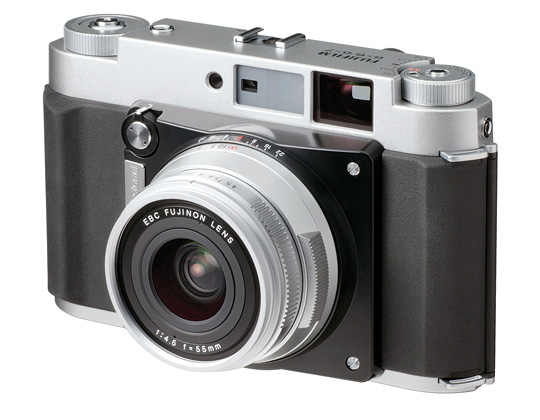
The Fuji GF670W was announced at Photokina 2010. The new medium format film camera is the wide angle version of the already existing Fujifilm GF670 rangefinder and will be rreleased on March 23rd in Japan. The Fuji GF670W has a Fujinon EBC 55mm f/4.5 lens (the previous version had a Fujinon EBC 80mm f/3.5 lens):
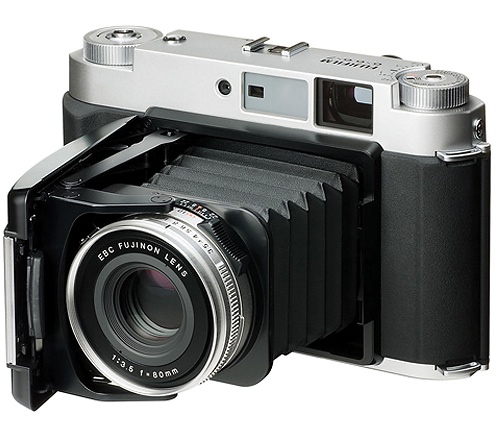
Fuji GF670W specifications:
| Format | 6 × 7cm size rangefinder camera with integration |
|---|---|
| Screen Size | 6 × 7cm, 6 × 6cm size switchable screen size The actual screen size: 6 × 7cm 56 size × 69mm, 6 × 6cm 56 × 56mm size |
| Using Film | 120/220 roll film |
| Number of shots. | Size 6 × 7cm exposures 120:10, 220:20 exposures Size 6 × 6cm exposures 120:12, 220:24 exposures |
| Lens | EBC FUJINON 1:4.5 f = 55mm Minimum focusing distance group consists of 10 8: 0.7m Aperture: F4.5 ~ F22 Diagonal angle size 6 × 7cm 77 ° (35mm equivalent to 27mm size) 6 × 6cm 72 size ° (35mm equivalent to 30mm size) |
| Focusing | Susumu Tadashi helicoid Manual (feeding total) |
| Finder | 6 × 7cm, 6 × 6cm screen change size in bright automatic switching Viewfinder Magnification: 0.52 times baseline length: 37.2mm (effective baseline length: 19.3mm) Rangefinder works: 0.7m ~ auto-correction field of view Parallax ∞ 3m 90% |
| Viewfinder | Shutter speed shooting mode, exposure warning outside of work, the battery voltage warning |
| Display shutter blade open | Viewfinder eyepiece at the bottom LED (red) light |
| Shutter | Electronically controlled lens shutter Valve, 4 seconds to 1 / 500 sec |
| Synchro | X sync terminal contacts sync at full speed, with hot shoe |
| Exposure Control | Center-weighted averaging metering (metering external) photodetectors: SPD relative range: EV1.3 ~ 18 (ISO100) |
| Shooting Mode | Aperture-priority AE, manual exposure, AE lock by pressing the shutter button halfway |
| Exposure compensation | ± 2EV 1 / 3 step increments |
| Film speed | Manually set ISO25 ~ 3200 (1 / 3 step increments) |
| In loading the film | Manual |
| Film feed | Dial hoisting ceremony |
| Frame counter | Mechanical counter with auto-switching 120/220 slide film pressure plate Auto Reset Open Back, 6 × 7cm, 6 × 6cm in size switching automatically switches the screen size counter |
| Power | Lithium battery CR2 (3V) 1 |
| Exterior Design | Body: die-cast aluminum exterior components include: magnesium alloy |
| Other | Cable Release Tripod screw hole Screw hole Firumuinjiketapoketto |
| Size | 178 (W) × 109 (H) × 89 (D) mm |
| Weight | 1100g (by battery) |

Related posts:
- Pentax got a new 25mm f/4 wide angle lens for their medium format 645D camera
- Arca Swiss Rm2d medium format camera
- Rumor: Samsung, Schneider – Kreuznach and Alpa to create the first, fully digital, medium format camera system
- Samsung: “We have the technology to develop a medium format cameras but we are not going to do that”
- Samsung working on a medium format digital camera system?


31 Comments
finally, a camera worth waiting for…
I just wish fuji would bring back 160s in 4×5. it kills me that they stopped producing sheets, but still have those stupid quickload things…
I agree. 160s is great. QL is gone too fyi.
you sure? B&H still has it.
http://www.bhphotovideo.com/c/product/396038-REG/Fujifilm_15474713_Pro_160S_4x5_Quick.html
I never much cared for any of their negative film, except Superia 400, oddly enough.
But Astia 100 for people and Velvia 100 for landscapes! That’s a different story.
Did you ever try the neopan b&w film? before the discontinued the 1600 version I bought a case of it I like it so much. Ilford is great, but i always preferred fuji for b&w. I just pray they never discontinue velvia 120 film.
I never did try Neopan.
And I’m very much with you on Velvia 120/220. That stuff is incredible, vastly better than any digital system that I can afford.
I used to use Delta 3200 until I discovered Neopan 1600. Best high speed BW film I’ve ever used. Shot the last roll I had of it yesterday.
beautiful…
no, unless mamiya 645 mount adapter will be provided
number of people shooting film in rangefinder is too small
should have been *MF film*
Its a fixed lens. What adapter?
I would agree with you except I’ve known a lot of people getting reinterested in MF just because the price point has never been lower.
How do these compare in features and performance to the Mamiya 7II, Plaubel Makina 67/ W67 of yesteryear? Are they competitive compared to the second hand value of these classics?
A quick perusal of http://www.keh.com shows a Mamiya 7 body in BGN grade (which I am comfortable buying from KEH, your mileage may vary) for $525 and the 50mm f4.5 with all the goodies (hood, cap, etc) for $1479.
A Bronica RF645 is $665, but the only lens they have for it is a 65mm f4 for $119.
I think I’d prefer the Fuji, if I could afford it, and if I really wanted to shoot 6×7. But I’ve found that 6×4.5 is more than adequate for enlargements to 20×30 when developed and scanned (Enhanced Scan product) at North Coast Photo in California. 17MP scans from medium format film print surprisingly well.
Thanks for the comment. I was more looking for hands-on information. I shot mostly Rollei TLRs in MF, but some of my friends are classic folder fans. One told me how he used them as back-up cameras for weddings and for travel photography – his prints are exquisite. I am told the Makina W67 is a fine camera optically, but not as robust as the Mamiya 6 & 7, that it suffers from a bad film winder and rickety bellows frame. Many photogs consider the Mamiyas as the best hand-held, neck slingable film cameras ever, though they can’t agree whether it’s the model 6, 7, or 7II. It’s pretty much the benchmark by which cameras are compared. it’s not very sophisticated, though it does have AP and metered manual and you can change lenses. The lenses are great. Not good, great.
I have never met anyone who’s used a GF670/BessaIII, but I have read that they are a cheaper camera, with inferior build (bellows lever prone to breakage) and inferior optics to a Mamiya 6/7 (despite the Fujion EBC coating); they just cost more new and that second hand prices reflect the Mamiya’s premium quality. I guess you should think of the Bessa III as a fixed lens, medium format Bessa R, but priced an order of magnitude higher.
I want to know if the Fuji GF670W is built to last, as sharp as a Mamiya and priced affordably, or is it just a wide GF670?
That’s a question I’m afraid I don’t know the answer to.
I have considered the GF670 for portaiture, since my Mamiya 645AF (which I love, and yes, the glass is excellent) does have some focusing and exposure foibles. But I also use the 645AF for landscape work, for which I find a polarizer almost mandatory.
Not really something that works well on a rangefinder.
Well, this is not the camrea I have interest in, but this is so good that nowadays someone is still producing film cameras! I have a little gleam of hope that Nikon will introduce something for film-lovers in 35mm format.
Cost?
To be honest, don’t know.
the price is not announced yet
It is good to see a new medium format FILM camera.
There is nothing to compare (in my world at least) to a beautiful, perfectly exposed, thought-out, TRANSPARENCY.
Looks like a great compact ‘field camera’ for a remote ‘outworld’ trip, or at least, simply an easy to use, carry-round’ camera.
I’ll bet this retails for $2000. I love my Pentax 6×7 for black and white, but it is a little heavy (4 pounds). I really do like having a built in meter, something older folders usually do not have. There aren’t many 6×7 folders, though, that don’t cost a pile of money.
The second picture made me wonder WHAT IF someone would make a large sensor (FF or MF) mirrorless digital cam with a good prime lens…
You mean like a Leica M9 and M mount primes?
Or did you mean like a Horseman SW-D II Pro with your choice of digital back and Schneider APO-Digitar or Rodenstock APO lenses?
Beautiful. I’m guessing about $2000 minimum.
It’s a lot to expect people to understand f-number equivalence between formats and consider film as an alternative to digital but… would it hurt so bad for Fuji to put some lenses that are equivalent to at least 135 format f/1.4 lenses (which are only f/2.8 on 6×7) instead of this 135 format f/2.3 equivalent lens (f/4.5 on 6×7)!?
I still advocate a medium format DIGITAL range-finder camera. Why the heck not? It would be cheaper, smaller, lighter… I had this (simple) idea over a year ago, and was chastised quickly on another forum (DPReview). The only problemo would be lenses, I guess, but with medium format sensor, digital zooming and cropping would be possible…
Anyone?
I’m with you. A digital Leica M9 with a 4:5 aspect ratio sensor would be absolutely killer for professional work. 44x55mm sensor size would be the minimum I would consider sufficient, otherwise one might as well just buy the Pentax MF offering.
Well, that was rather confused. A medium format Leica M9 is what I meant to say.
I had the opportunity to hold this camera (GF670W) during my recent trip to Japan. It feels really nice in the hands. Not a surprise it’s similar build quality to the GF670. Have not shot with it. This focal length appeals more to me than the existing GF670. That being said, my GA645 is still going strong… I have no idea about pricing. I figure Fujiya will have best pricing in the Tokyo metroplex based upon my experience. I’ll probably look for a nice used copy a few months after official release.
I had a hard time breathing when I saw the picture. It is exciting when new film cameras are released because it doesn’t happen very often.