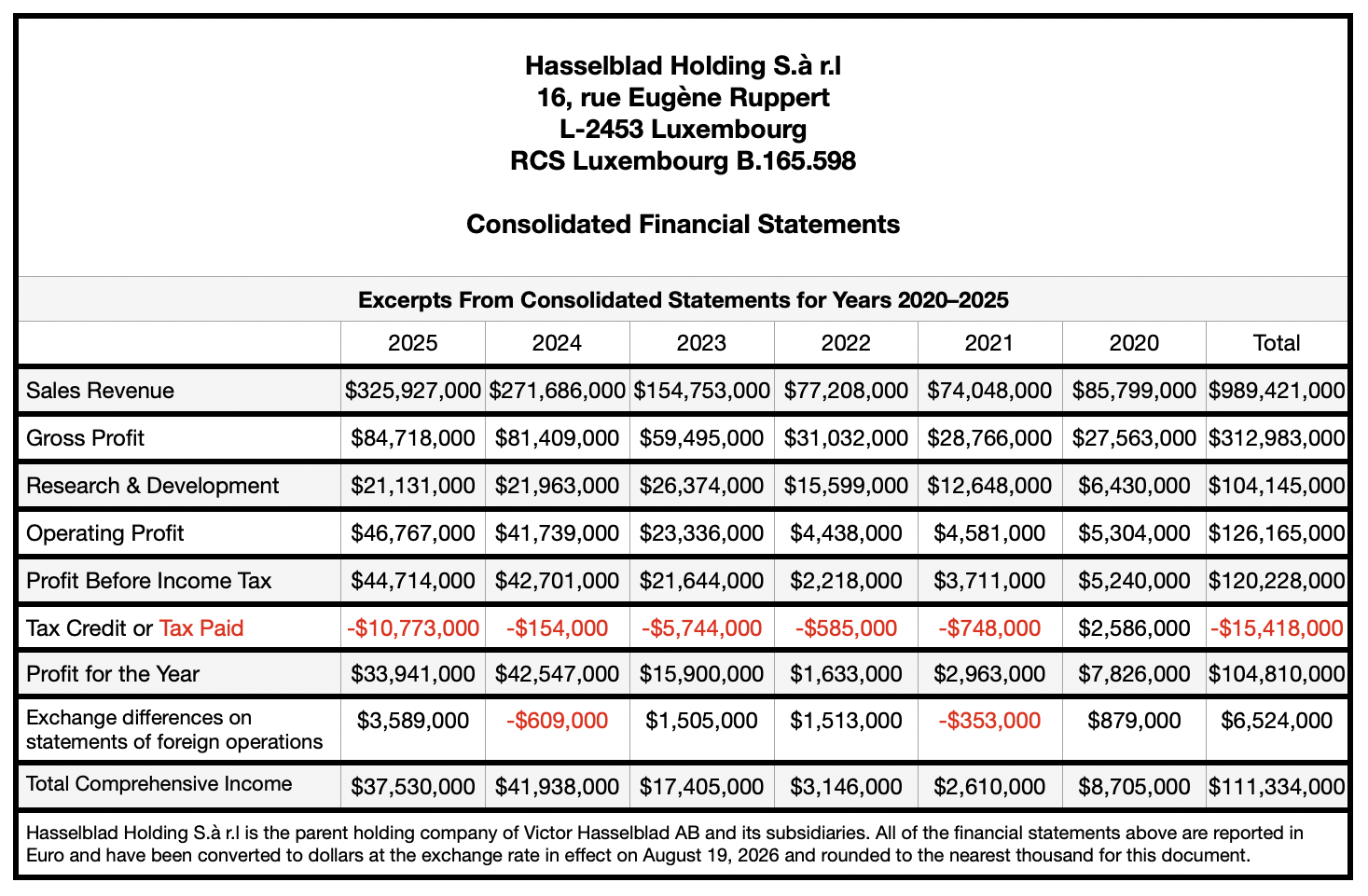
Hasselblad operates as a private company under its parent entity, DJI, so it does not publish detailed quarterly earnings calls or SEC-style public reports. However, official annual corporate filings submitted by its operating subsidiaries (Victor Hasselblad AB in Sweden and Hasselblad Holding S.à r.l. in Luxembourg) reveal the following recent financial figures:
All figures below are the dollar-converted figures from the financial table you provided; the actual filing is in euros.
| $ millions | 2025 | 2024 | Change |
|---|---|---|---|
| Sales revenue | $325.9M | $271.7M | +20.0% |
| Gross profit | $84.7M | $81.4M | +4.1% |
| R&D | $21.1M | $22.0M | −3.8% |
| Operating profit | $46.8M | $41.7M | +12.0% |
| Profit before tax | $44.7M | $42.7M | +4.7% |
| Tax credit / (tax paid) | −$10.8M | −$0.2M | — |
| Profit for the year | $33.9M | $42.5M | −20.2% |
| Total comprehensive income | $37.5M | $41.9M | −10.5% |
Hasselblad’s revenue has grown dramatically over the past three years:
So revenue has more than quadrupled since 2022 and increased almost 4× between 2020 and 2025. The implied 2020–2025 revenue CAGR is approximately 30.6%.
This is probably the most interesting part of the results. Hasselblad’s gross profit increased only from $81.4M to $84.7M, despite revenue increasing by $54.2M. That means the gross margin fell from approximately:
That’s a substantial deterioration. For comparison:
| Year | Revenue | Gross margin |
|---|---|---|
| 2020 | $85.8M | 32.1% |
| 2021 | $74.0M | 38.8% |
| 2022 | $77.2M | 40.2% |
| 2023 | $154.8M | 38.4% |
| 2024 | $271.7M | 30.0% |
| 2025 | $325.9M | 26.0% |
So despite the enormous increase in sales, Hasselblad is generating less gross profit per dollar of revenue than it did several years ago.
Matt Granger’s Hasselblad Expert Setup Guide now updated for the latest X2DII camera & 35-100mm lens
Despite the weaker gross margin, operating profit increased from $41.7M to $46.8M, or approximately 12%. Operating margin was:
So operating profitability remained quite strong, but the margin slipped. One notable factor is R&D. Hasselblad spent approximately $21.1M on R&D in 2025, down from $22.0M in 2024 and $26.4M in 2023. R&D therefore represented about 6.5% of revenue in 2025.
This is where the headline looks less impressive. Hasselblad’s profit for the year fell from $42.5M in 2024 to $33.9M in 2025, a decline of approximately 20%. The difference is particularly notable because operating profit actually increased. The table shows a $10.8M tax expense in 2025, compared with only about $154,000 in 2024. That explains much of the gap between the improvement in operating profit and the decline in net income. Net margin consequently dropped from approximately 15.7% in 2024 to 10.4% in 2025.
The overall trajectory is striking:
| Year | Revenue | Operating profit | Net profit |
|---|---|---|---|
| 2020 | $85.8M | $5.3M | $7.8M |
| 2021 | $74.0M | $4.6M | $3.0M |
| 2022 | $77.2M | $4.4M | $1.6M |
| 2023 | $154.8M | $23.3M | $15.9M |
| 2024 | $271.7M | $41.7M | $42.5M |
| 2025 | $325.9M | $46.8M | $33.9M |
In other words, 2025 was Hasselblad’s biggest sales year by a very large margin, and operating profit was also a record in this six-year series. But 2024 was actually the better year for bottom-line profitability.
You can download the financial records from this page.
The latest financial results from Nikon, Fujifilm, Tamron, GoPro, Kodak, and Panasonic