US patent 7725016 from Samsung is for a liquid zoom lens. The idea behind this patent is to reduce the size and power consumption of a conventional lens. This technology could potentially be used in mobile devices:
“Consequently, the zoom camera of the disclosure has a disadvantage in that it requires a large space for the zoom operation within the camera.”
“In addition, since the motor of the camera is inevitably operated in such a way so as to push the inner and outer barrels having the plural lenses received therein to an outside of the zoom camera, loss of power during driving of the motor causes an increase in power consumption of a battery.”
“In order to solve the problems as mentioned above, a liquid lens has been developed, which occupies a small space within the mobile terminal and does not suffer from power consumption. The liquid lens comprises a electrolyte and an insulating liquid in a single lens barrel to form an interface there between, of which curvature is changed by application of voltage to the electrolyte through the lens barrel, in order to embody the zoom function.”
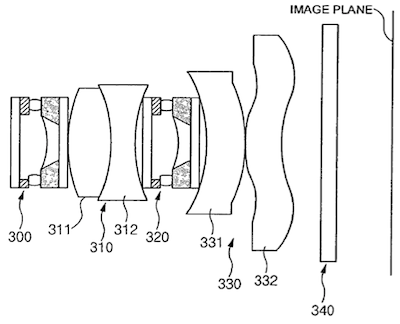
cross-sectional view of a liquid lens
“The conventional liquid lens includes a first group of lenses 310 composed of a first lens 311 with a positive refractive index and a second lens 312 with a negative refractive index, a first liquid lens 300 having an interface formed between a conductive liquid and a non-conductive liquid and varied in curvature in response to a control signal for a zoom function, a second group of lenses 330 composed of a third lens 331 having both aspherical sides with a positive refractive index and a fourth lens 332 having both aspherical sides with a negative refractive index, and an infrared filter 340 spaced a predetermined distance from the second group of lenses 330.”
In addition, Samsung is working closely with Lensvector Inc. to create a Solid-Stated AF systems for smart phones (FYI – PDF file: Samsung is an investor in Lensvector). The advantages of a liquid zoom lens are:
- no moving parts
- less power consumption
- no need for AF motor
- faster electrical response
- silent operation
- lightweight
- small size
About LensVector:
“LensVector AutoFocus (LVAF) is the world’s smallest autofocus device. LensVector uses a unique, patented technology to transform a simple liquid crystal (LC) cell into a variable focus lens. Rather than physically moving a lens element like traditional mechanical solutions, LensVector applies a small control voltage to dynamically change the refractive index of the material the light passes through. LensVector carefully controls the rotation of the molecules in the LC cell to achieve this change in refractive index. Because the resulting solid-state autofocus element has no motor or moving parts, it is more rugged and reliable than mechanical alternatives. LVAF provides change of focus from infinity to 10 centimeters with good optical performance.”

click to enlarge