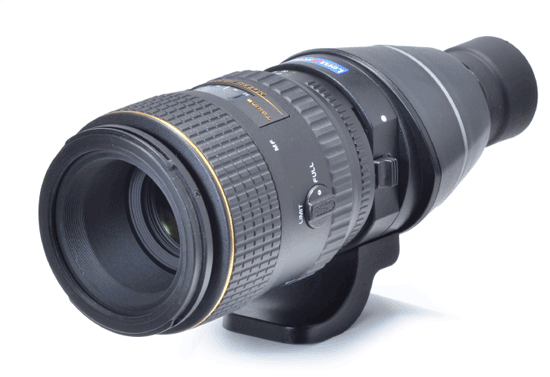
I was doing some research online for lens scope converter in connection to a recent guest post on NikonRumors and it seems that Kenko recently released the Lens2scope - a spotting scope adapter for camera lenses, available for Nikon and Canon mounts. This adapter will let you use your existing lenses as a telescope with a 10x magnification. Check Amazon for pricing.
| Eyepiece focal length | 10mm | Brightness | F4 |
|---|---|---|---|
| Lens Construction | Five three groups | Prism system | Dahapurizumu |
| Angle of view | 42 ° | Pupil diameter | 2.5mm |
| Eye Relief | 20mm | Loupe magnification | Magnification macro lens (1:1) When mounted on a 25-fold |
| Size | Length 110mm (135mm with a tripod collar included) × Height 90mm Width 80mm × |
Weight | 185g |
| Accessories | Case with | Lens Mount | Nikon F |
| Code | 5673216421249 | Retail price (excluding tax) | ¥ 20,000 |
Related posts:
- SLR Magic 12-36×50 ED spotting scope for Micro Four Thirds announced
- Sony will release also a NEX adapter LA-EA2 for A-mount lenses
- Kenko to unveil their interchangeable lenses digital camera tomorrow (C-mount) *UPDATED*
- Micro Four Thirds adapter for EOS lenses
- The new Kenko digital camera with interchangeable lenses prototype got lost on its way to Photokina


26 Comments
Well it doesn’t seem to be a kenko product: http://www.lens2scope.com/product.html
Amazon has it ( http://www.amazon.com/Lens2scope-10mm-Eyepiece-Nikon-Angle/dp/B004GGNGV4/ref=sr_1_2?s=electronics&ie=UTF8&qid=1319332919&sr=1-2 ) but they say it is for DX lenses only. do anybody understand why?
From what I can tell, they mean it works with FX and DX lenses, not just FX.
Hmmm. Amazon has all mounts available except Nikon. Go figure…
Dx pnly doesn’t make a lot of sense. Teh mount is the same and the adapter apparently only uses the center of the lens circle with a 10X eyepiece. Might be fun if I could use it with my 200-400!!!
They should make a model with a battery that can power the lens VR
I’m not buying one until they release the next version with a 3″ tilt LCD and an APS-C sensor that can do stills+1080 video on to a SD card ;P
10x magnification?
How are these things calculated? For what lens is that magnification?
Ever thought if these before. Can someone break it down real quick?:-)
I think that is a typo . . . from the DPReview article on the Nikon product . . .
“The power of the telescope is calculated by the focal length of your lens divided by 10, in my case a 51x telescope.”
Read more on NikonRumors.com: http://nikonrumors.com/2011/10/20/how-to-convert-your-nikon-lens-into-a-telescope-or-a-microscope-nikon-lens-scope-converters.aspx/#ixzz1bahrMabY
It’s quite simple really
FX is considered 1x Magnification
So a 50mm lens acts as a normal 50mm
DX is 1.5x so a 50mm = 75mm
(kind of)
so 10x means that
50 x 10 = 500mm Lens (Kind of)
So if you have a 100mm lens on it
it will function (for the most part)
as if you had a 1000mm lens
Even simpler… the eye-piece magnifies a frame that is 1/10th of the width of a full 35mm frame.
Dahapurizumu? My Japanese is a little rusty, but my German is not: this awfully sounds like “Dachprisma”, which, one of those trusty online dictionaries says, is an Amici-prism. It would fit the purpose.
The Japanese are known for their misuse of technical terms… e.g. “translucent mirror”…
No… crop factors have nothing to do with this. Crop factors just tell you the area the senesor covers.
The focal lenght of a lens is the same even if it’s DX… DX lenses just have less coverage… they cover a area that is smaller, so that’s why you get extreme fall-off when used on a FF camera.
So it really all comes down to how the adapter was designed and eye relief… you well get a different experience using a 400mm DX or 400 FX lens.
Does it have AF and IS/VR?
u want AF on a scope?
That was the main problem Columbus had in his day… Didn’t you know?
Well, Keppler had solved it. And so did Galilei.
Stupid Christopher to try it on a boat…
(by the way did he? I thought he used eggs to find out if he had reached land.)
It works well for me using long lenses, so why shouldn’t it work well on a scope, particularly if its already built in?
Has been available for some time
Yepp. It’s been available since last year. And I can see it being a great thing for wildlife photographers. Especially the ones who don’t have enough room to carry around around another long lens, or real spotting scope.
The magnification of a telescope is giverned by the focal length of the telescope (lens) and the magification of the eyepiece. Therefore this telescope adapter will produce a different magnification with lenses of different focal length. What would be really helpful would be if they told you what magnification a given focal length of lens produces. Just saying it gives 10x is misleading.
so this crops the picture giving you reduced resolution?
Magnification calculation is simple. Focal length of lens divided by focal length of eyepiece, in this case 10mm, so a 500mm lens would yield 50X, a 100mm lens would yield 10X, a 70-200mm lens would be a 7X-20X zoom scope. It has nothing to do with crop factor, whether a lens is FX or DX, etc. Put your 2X teleconverter on the 70-200 and now you would have a 14X-40X scope.
Forgot to mention that I made a simple eyepiece adapter long ago for Nikon lenses, including AF-S, so that I could use any of my telescope eyepieces on it, to increase or decrease the magnification. It’s not all that hard to make out of a rear lens cap and a Celestron 1.25″ Visual Back. You just cut a 1.25″ hole in the center of the cap and glue the visual back on it. Then grab any old 1.25″ telescope eyepiece to use. For an AF-S lens you need to make a little plastic peg to hold the aperture lever open, otherwise it’s all of the way closed.
How many mm Celestron 1.25″ eypiece do you use and why?