DxOMark: Fuji X100 outperforms 4/3 sensors

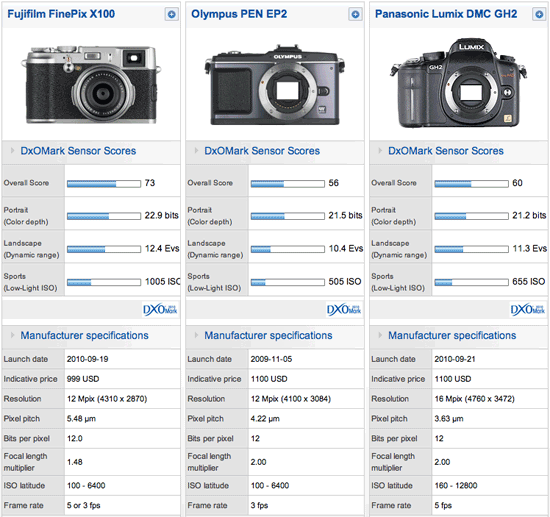
DxOMark published new test data today for the Fuji X100 camera (see review). Here is the comparison with the Olympus PEN EP2 and Panasonic GH2:
See some more new DxOMark test data on NikonRumors.com.

This entry was posted in Fuji, Olympus, Panasonic and tagged , . Bookmark the permalink. Trackbacks are closed, but you can post a comment.
  • jason

    X100 rulz!!!!!

  • http://documentarypictures.com JB

    No surprise there- the Fuji has a larger sensor than the two cameras you compare it with and costs hundreds of dollars more ($650 more in the case of an E-PL2 with kit lens).

    The question is what advantage does the Fuji over APS-C cameras, such as a Nikon D7000 outfitted with a 35mm f/1.8. An inch less height and few less ounces? For me, not enough. Without strong manual focusing capability, this camera is a non-starter.

    • http://twitter.com/#!/ZDP189 ZDP-189

      Yes, we get that. Every thread regarding the X100 has a token flippant dismissal from you. You won’t buy it. Many others have and will.

    • Nerdpin

      The EP2 and EPL-2 are different cameras. The EP2 costs 250 more then the EPL-2 brings the prices closer. The form factor and size are comparable so it is a direct comparison. If size and cost are similar, then its safe to compare them. The oly’s do have the option to use other lens where the fuji is fixed. Some people could shoot one lens and never need to switch, where others would never be able to limit themselves with such a limitation. I think both systems have some awesome features, I would like a cheaper alternative to a Leica M9 personally as I find manual focus makes the experience so much more personal and enjoyable.

  • Nathan

    Uh, yeah. of course it does. It’s also heavier and more expensive in most cases, and only has one focal length. But its primary competitor is u4/3 I suppose.

  • PaoloB

    I have some doubts about the testing performed by DxO Marks in this case.
    If you look at the results in detail, you will see that one factor that hugely limits the overall score is the ISO sensitivity: it seems that 1600, 3200 and 6400 settings are in reality about 1000 ISO (all of them). This is totally different from what I can see in other web testings, such as http://www.lenstip.com, where there are real word shots of the same scene at various ISO settings (ISO 200, 400, 1600, 3200 and 6400). With aperture fixed at f:5,6 for all shots, you can see that the increase in shutter speed is almost aligned with the increase of sensitivity.
    So DxO Marks has better to check the sample used in this test…

    • http://twitter.com/#!/ZDP189 ZDP-189

      I too, no longer trust DXO mark. Some cameras that do really well in extremes of low light have scored poorly in their sensor matrix. The XZ-1 is an example. From the stats, it looks very weak, but it can resolve a lot of detail you can’t make out with the naked eye in low light. It doesn’t take into account that a lot of people shoot JPEGs and some cameras post-process better than others. It doesn’t give a real-world picture of resolving power (AA vs non-AA) and I feel that it doesn’t give a true picture of colour rendition and dynamic range.

      having said all that, I have had some tremendous results with the X100 last night in a club shooting in low(no) light. I was asked to take photos for the performers’ record. it’s not a paying job and there’s no special photographer access/pit, so I brought a compact, the X100. When I got there I was staggered by the low light. There were no spots and so little ambient or stage lights that you could just about move about, but it was really dark. I couldn’t use flash or even the AF-assist beam or I’d have blinded the performers. At the same time, I couldn’t shoot a long exposure, because of the jostling and the singers were always moving. So 1/30s was the slowest I could go. I was working at ISO 12800, f/2 with guestimated manual focus distance. The feeling I got was I would have done better with a 5DII and 85/1.2, but I got far better images than another chap with an APS-C DSLR. He gave up early on.

  • James B

    as said, larger sensor makes it pretty predictable that X100>M43, test shots pretty much already decided that, especially high ISO stuff. Much more interesting I think is to compare it to other current APS-C cameras, Canon 1100D it bests, the nikon it matches overall, although the mid/pro level nikons seem to own all

    I’m impressed

    WAAAANT

  • Lars

    What is more interesting is how it performs when compared with NEX 5, which of course uses an older sensor and the old nikon D90 it bests nex 5 , of course the newest nikon D7000 is better, it seems as mirrorless cameras are held back by having to make do with only the previous generation sensors, and not the cutting edge newest. Too bad this will make me buy D7000 instead, but maybee the pentax apsc with k mount has the newest sensor as K5, that would make it the best mirrorless yet. Here is fingers crossed. And the stats

    DxOMark Sensor Scores
    Overall Score 69
    Portrait
    (Color depth) 22.2 bits
    Landscape
    (Dynamic range) 12.2 Evs
    Sports
    (Low-Light ISO) 796 ISO

    and is similar to nikon D90 even has the same score:
    Overall Score 73
    Portrait
    (Color depth) 22.7 bits
    Landscape
    (Dynamic range) 12.5 Evs
    Sports
    (Low-Light ISO) 977 ISO

  • Captain Cook

    It will be interesting to see comparison with cameras that have same crop factor for example Samsung NX and Sony NEX Series.

    • Lars

      Eh did you not see my post? No need to consider nx11 NEX5 is better:

      NEX5:
      DxOMark Sensor Scores
      Overall Score 69
      Portrait
      (Color depth) 22.2 bits
      Landscape
      (Dynamic range) 12.2 Evs
      Sports
      (Low-Light ISO) 796 ISO

      Nikon D90:
      Overall Score 73
      Portrait
      (Color depth) 22.7 bits
      Landscape
      (Dynamic range) 12.5 Evs
      Sports
      (Low-Light ISO) 977 ISO

      Nikon D7000:
      Overall Score 80
      Portrait
      (Color depth) 23.5 bits
      Landscape
      (Dynamic range) 13.9 Evs
      Sports
      (Low-Light ISO) 1167 IS

  • http://twitter.com/#!/ZDP189 ZDP-189

    Here’s a reminder for the scroll-challenged:

    Fujifilm FinePix X100
    Overall Score 73
    Color depth 22.9 bits
    Dynamic range 12.4 Evs
    Low-Light ISO 1005 ISO

    And comparisons:

    Let’s not mention the compacts unnecessary humiliation. The best score was the Canon Powershot G12 and S95 with 47 points. It’s unfair to compare the small sensor Micro Four Thirds cameras too. The E3 manages a valiant 56 points and the GH2 is the only one that does better at 60.

    OK, here’s the proper competition:

    Sony NEX3
    Overall Score 68
    Color depth 22.1 bits
    Dynamic range 12 Evs
    Low-Light ISO 830 ISO

    Samsung NX 100
    Overall Score 62
    Color depth 22.6 bits
    Dynamic range 10.7 Evs
    Low-Light ISO 563 ISO

    Samsung NX10
    Overall Score 63
    Color depth 22.8 bits
    Dynamic range 10.8 Evs
    Sports Low-Light ISO 572 ISO

    Samsung NX10
    Overall Score 63
    Color depth 22.7 bits
    Dynamic range 10.8 Evs
    Sports Low-Light ISO 553 ISO

    Sigma (not tested)

    They didn’t test the X1…
    Leica X1 (not tested)

    … so how about the M8?
    Leica M8
    Overall Score 59
    Color depth 21.1 bits
    Dynamic range 11.3 Evs
    Low-Light ISO 663 ISO

    OK, at least the latest mega-bucks full-framed Leica M9’ll beat it?
    Leica M9
    Overall Score 69
    Color depth 22.5 bits
    Dynamic range 11.7 Evs
    Low-Light ISO 884 ISO
    No, the Leica M9 fails to match the X100 in all categories tested.

    For a bit of a laugh, I also compared it against the latest crop of APS-C and full frame DSLRs. It beat the Pentax K7, K-x and K-r. It beat the Nikon D300S, D3100 and D5000. It beat the Sony Alpha 290, 390, 450, 550, SLT Alpha 33 and equalled the SLT Alpha 55. It beat the Canon EOS 1100D, 600D, 60D, and even the 7D. It beat the Canon EOS 1D Mark III and came within one point of the Canon EOS 1D Mark IV and 1Ds Mark II.

    So in summary, the X100 beat every compact, or mirrorless camera tested ever tested by DxOMark and just about every consumer DSLR and the best part of the prosumer DSLR flock too.

    I do not 100% trust DxOMark’s scores as the definition of a great sensor. There’s a lot more to it than this and inferior scoring cameras often turn out equal or superior images. However, in this game of “DxOmark Trumpcards” which we find ourselves playing, the X100 is a surprisingly strong card to hold.

  • Back to top