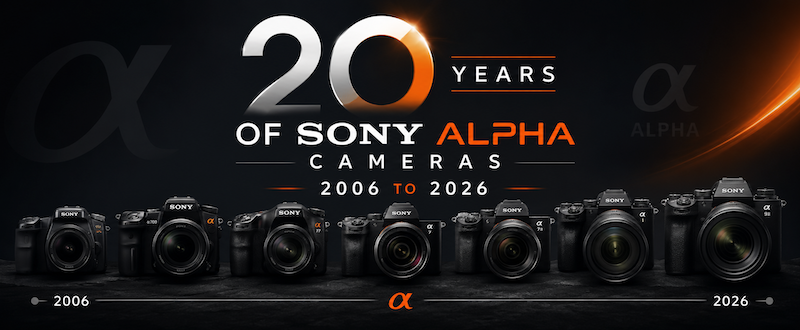
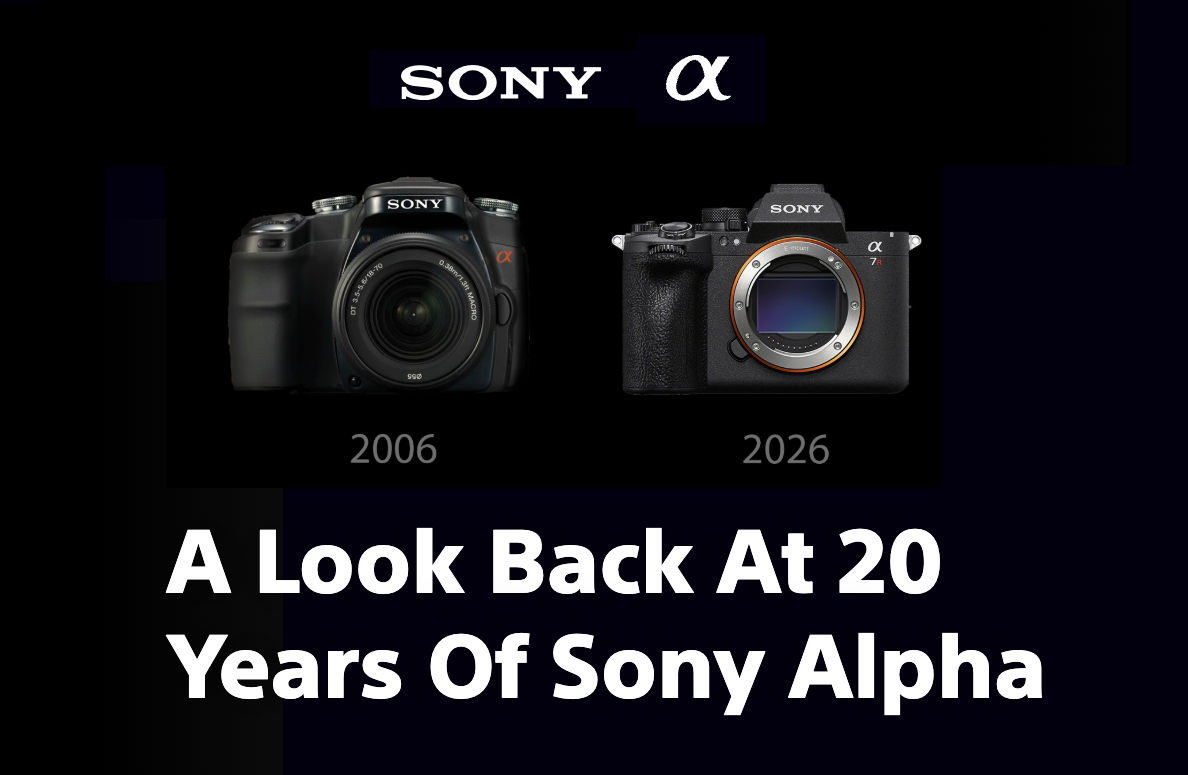
Exactly 20 years ago today, on June 5, 2006, Sony announced the Alpha 100, the camera that launched the Sony Alpha system. What began as an outsider’s entry into the DSLR market, built on the Konica Minolta A-mount platform acquired by Sony, has evolved into one of the most innovative and influential camera lines in the history of photography and videography.
Two decades later, Sony Alpha stands as a benchmark for hybrid photo/video performance, autofocus intelligence, resolution, and speed. From the groundbreaking in-body stabilization of 2006 to the global-shutter flagship of 2023 and the highest-resolution Alpha camera yet in 2026, the journey has left a significant mark on the industry.
The Early Years (2006–2012)
Sony entered the digital camera arena by acquiring Konica Minolta’s camera division, inheriting the A-mount lens ecosystem. The Alpha 100 (10.2MP APS-C CCD) introduced SteadyShot INSIDE in-body image stabilization- a major first for compatible lenses at the time, along with the BIONZ processor and an accessible price point for enthusiasts.
The system quickly expanded:
- 2007: Alpha 700 brought a 12.2MP CMOS sensor, better AF, and a magnesium body.
- 2008: The Alpha 900 became Sony’s first full-frame DSLR, featuring a 24.6MP sensor and the world’s first full-frame in-body stabilization.
- 2009–2010: Entry-level and mid-range DSLRs proliferated (A200/A300 series, A500/A550). Then came the revolutionary SLT (Single Lens Translucent) cameras: the Alpha 33 and Alpha 55 in 2010, which used a fixed translucent mirror for continuous phase-detection autofocus during both stills and video.
The SLT line peaked with the Alpha 99 (2012), the world’s first full-frame SLT, delivering 24.3MP and full-time phase-detect AF.