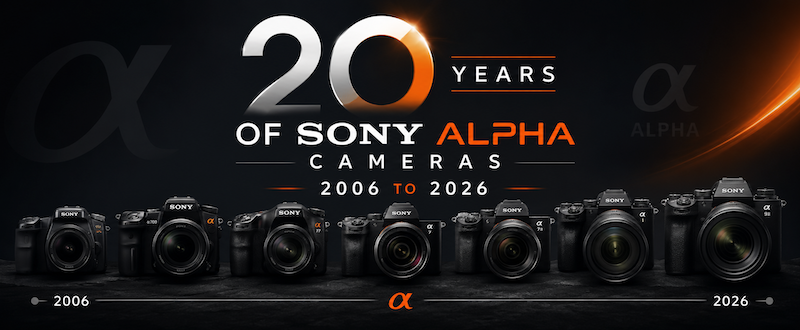
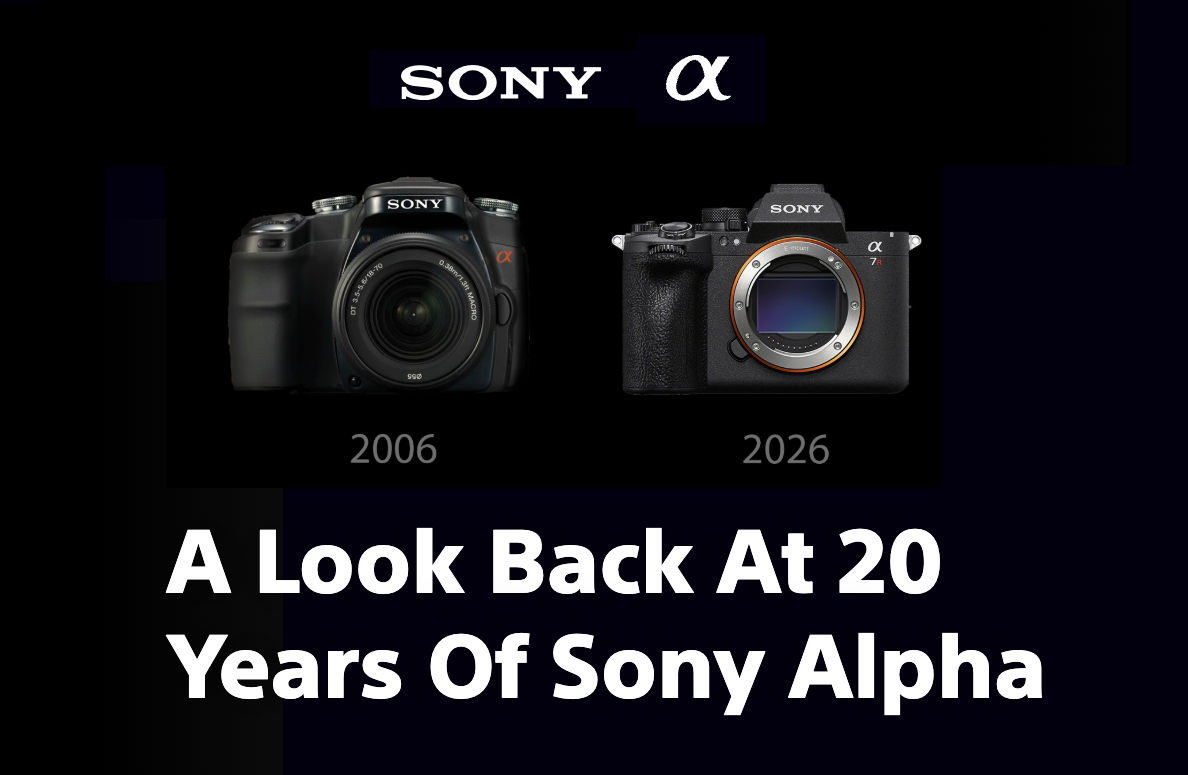
Exactly 20 years ago today, on June 5, 2006, Sony announced the Alpha 100, the camera that launched the Sony Alpha system. What began as an outsider’s entry into the DSLR market, built on the Konica Minolta A-mount platform acquired by Sony, has evolved into one of the most innovative and influential camera lines in the history of photography and videography.
Two decades later, Sony Alpha stands as a benchmark for hybrid photo/video performance, autofocus intelligence, resolution, and speed. From the groundbreaking in-body stabilization of 2006 to the global-shutter flagship of 2023 and the highest-resolution Alpha camera yet in 2026, the journey has left a significant mark on the industry.
The Early Years (2006–2012)
Sony entered the digital camera arena by acquiring Konica Minolta’s camera division, inheriting the A-mount lens ecosystem. The Alpha 100 (10.2MP APS-C CCD) introduced SteadyShot INSIDE in-body image stabilization- a major first for compatible lenses at the time, along with the BIONZ processor and an accessible price point for enthusiasts.
The system quickly expanded:
- 2007: Alpha 700 brought a 12.2MP CMOS sensor, better AF, and a magnesium body.
- 2008: The Alpha 900 became Sony’s first full-frame DSLR, featuring a 24.6MP sensor and the world’s first full-frame in-body stabilization.
- 2009–2010: Entry-level and mid-range DSLRs proliferated (A200/A300 series, A500/A550). Then came the revolutionary SLT (Single Lens Translucent) cameras: the Alpha 33 and Alpha 55 in 2010, which used a fixed translucent mirror for continuous phase-detection autofocus during both stills and video.
The SLT line peaked with the Alpha 99 (2012), the world’s first full-frame SLT, delivering 24.3MP and full-time phase-detect AF.
The Mirrorless Revolution Begins (2013)
In 2013, Sony fundamentally changed the industry with the launch of the Alpha 7 and Alpha 7R – the first full-frame mirrorless cameras. Compact, lightweight, and featuring hybrid AF and the new E-mount, they proved that professional image quality no longer required a bulky DSLR body. This was the true turning point. The E-mount system offered a shorter flange focal distance, enabling smaller, sharper lenses and paving the way for the vast native FE lens lineup we have today (while still supporting legacy A-mount glass via adapters).
Rapid Innovation and Category Leadership (2014–2022)
Sony didn’t rest. Key milestones followed at an impressive pace:
- 2014: Alpha 7 II introduced 5-axis in-body stabilization (IBIS) to full-frame mirrorless.
- 2015: Alpha 7R II brought a 42.4MP back-illuminated sensor and excellent 4K video.
- 2016: APS-C models like the Alpha 6300 and Alpha 6500 delivered class-leading autofocus speed and point counts.
- 2017: The Alpha 9 introduced blackout-free 20fps shooting with advanced tracking, redefining action and sports photography.
- 2019: Alpha 7R IV hit 61 megapixels; real-time Eye AF became a Sony signature.
- 2020–2021: Alpha 7S III redefined low-light video; the Alpha 1 combined 50MP stills with 8K video and 120 AF/AE calculations per second.
- 2022: Alpha 7R V introduced AI-based autofocus with subject recognition and improved ergonomics.
Pushing Boundaries: 2023–2026
Sony continued to break new ground:
- 2023: The Alpha 9 III became the world’s first full-frame global shutter camera (24.6MP), enabling true 120fps blackout-free shooting and pre-capture.
- 2024-2025: Refinements across the lineup, including the partially stacked sensor in the Alpha 7 V.
- 2026: The Alpha 7R VI arrives as the highest-resolution Alpha camera to date, further extending Sony’s dominance in the high-megapixel segment:

Why Sony Alpha Matters
Sony didn’t just compete; it often forced the entire industry to accelerate. The shift to mirrorless, the emphasis on hybrid video capabilities, compact pro bodies, advanced real-time AF (Eye AF, animal/bird/vehicle tracking), and stacked/global-shutter sensors all trace their significant momentum back to Sony’s Alpha developments.
Previous coverage of Sony cameras (all 1,633 blog posts) going back to 2009 can be found here.