Canon released its Q2 2026 financial results. Here is the recap:
- Market conditions remained weak in Europe, affected by the Middle East situation, and in the U.S., where the tariff impact persists.
- Net sales rose 3.6%, reaching a record high for a second quarter, driven by continued sales growth in compact camera and network camera businesses, and revenue growth in semiconductor lithography equipment driven by memory-related demand
- Higher costs resulting from a rise in memory prices and the Middle East situation, absorbed by refunds on additional U.S. tariffs and yen depreciation
- Increased operating profit by 35.2% to 159.2 billion yen
Details on the Canon Imaging Business:
- Camera sales increased significantly, driven by strong demand for compact cameras, which continued from the first quarter.
- For compact cameras as well, we will further increase production volumes in the second half of the year and aim to achieve full-year sales growth of more than 50%.
- For interchangeable-lens cameras, revenue increased as sales of full-frame models, led by the EOS R6 Mark III launched last November, grew compared with the first quarter, resulting in a higher average selling price.
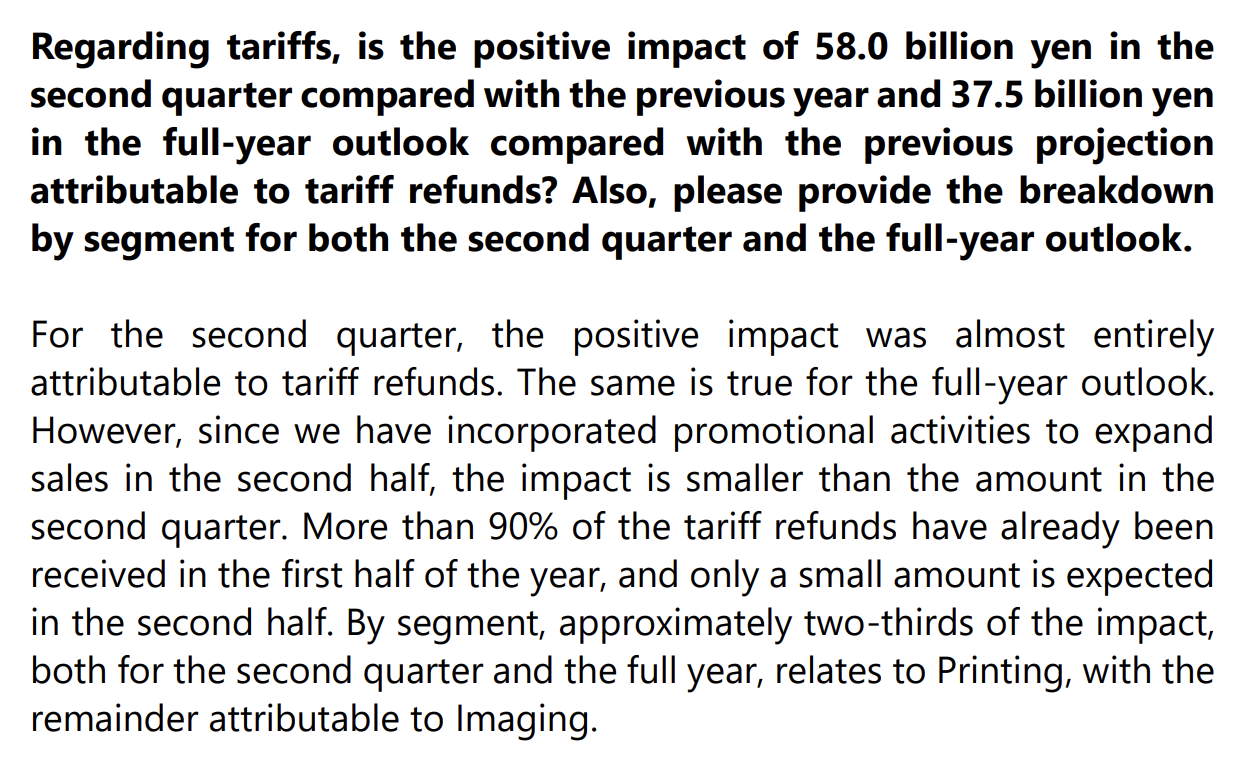
Canon got back 90% of the Trump tariffs that we, the consumers, paid through price increases:
Breaking: Canon to increase prices in the US as a result of the new Trump tariffs
Detailed Canon camera report:
The compact camera market continues to expand, driven by the growing number of new camera users, particularly among younger consumers. As for the interchangeable-lens camera market, while we lowered our outlook to reflect the impact of the Middle East situation, we still expect the market to reach 6.45 million units.
In the second quarter, compact camera sales increased significantly as we were able to meet strong demand through the production expansion implemented in the second half of last year.
For interchangeable-lens cameras, sales of full-frame models increased significantly compared with the first quarter, led by the EOS R6 Mark III, which was launched in November last year. Combined with an increase in the average selling price, this resulted in revenue growth of 12.9% year on year.
In the second half of the year, for compact cameras, which continue to perform strongly, we will further expand production capacity to eliminate supply shortages as quickly as possible and drive additional sales growth. For interchangeable-lens cameras, in addition to the EOS R6 Mark III, which contributed to sales growth in the first half of the year, we will strengthen sales of full-frame models, led by the EOS R6 V, a full-frame mirrorless camera for video creators launched in June. As a result, we aim to achieve full-year revenue growth of 11.6% for the camera business.
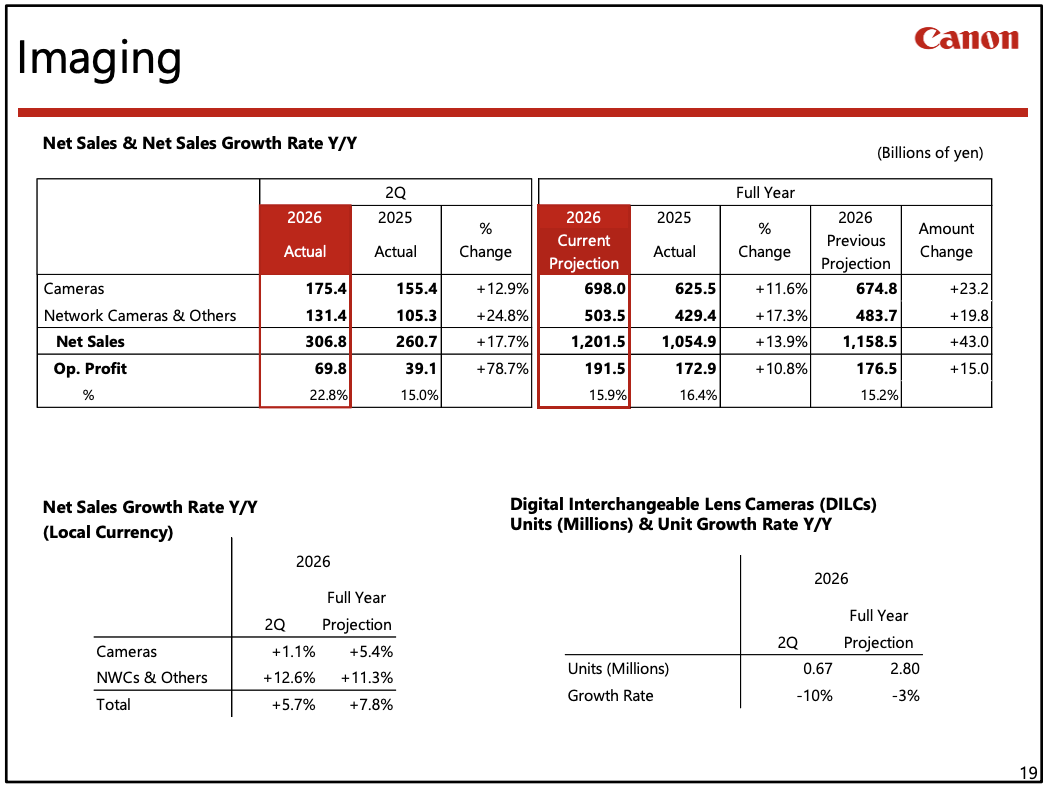
Recap of the latest Canon Q2 financial results (cameras):
- Cameras net sales: ¥175.4 billion, +12.9% YoY.
- Full-year 2026 Cameras sales projection: ¥698.0 billion, +11.6% YoY (revised upward).
- Strong demand for compact cameras continued from Q1 and was the main sales driver. Canon plans to further increase production in the second half and is targeting more than 50% full-year sales growth in the compact category.
- Interchangeable-lens cameras (ILCs): Revenue grew thanks to higher sales of full-frame models (especially the EOS R6 Mark III), which raised the average selling price.
- DILC unit shipments: 0.67 million units (down 10% YoY).
- Full-year DILC projection: 2.80 million units (up 15.9% YoY).
- Canon described the Imaging business as “highly profitable,” aided by the mix of higher-priced photography camera models. Full-year Imaging operating profit was raised to ¥191.5 billion (+10.8%).

Source: Canon